Limerence & Relationship Recovery
Limerence vs Love: How to Tell the Difference When Everything Feels Like Love
Every article that tells you this isn't real love feels like a dismissal. If it isn't love, why does it feel more intense than anything you've ever experienced? Why would you genuinely rearrange your entire life for a text message?
So let's not pretend it's shallow. What you feel is enormous and it is real. The question is what it's made of — and the answer changes what will actually help.
Part of our guide to limerence recovery and getting someone out of your head.
The one difference that explains all the others
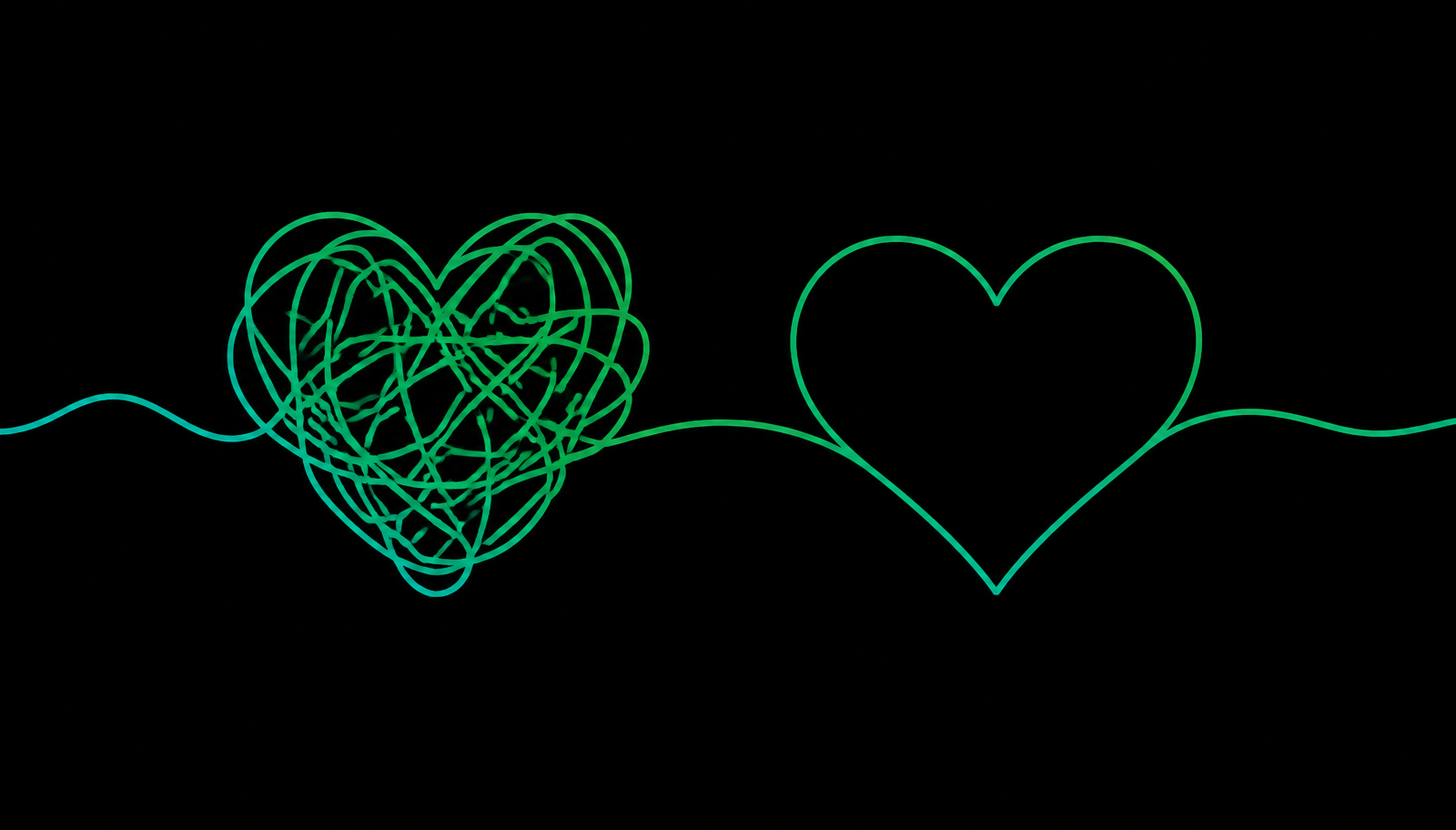
Limerence is organised around uncertainty. Love is organised around a person.
That sounds like a slogan until you test it. Think about when the feeling is strongest. Is it when they're warm, present and clearly yours — or in the gap after a message you can't interpret? Limerence spikes in the gap. Its fuel is not-knowing, and its central sensation is craving relief rather than wanting closeness.
Honest markers, not a quiz
- Who do you think about? Limerence thinks about how they feel about you. Love thinks about them — their day, their health, their life independent of you.
- What does availability do? Full, boring availability tends to deflate limerence and stabilise love.
- What do you know about them? Limerence often runs on very little actual information, filled in with projection. Love accumulates unglamorous detail.
- How do their flaws land? Limerence edits them out or reframes them as depth. Love sees them clearly and stays anyway, or leaves.
- What happens to the rest of your life? Limerence shrinks it — friends, work, sleep, appetite. Love generally expands capacity rather than consuming it.
- How does hope behave? Limerence needs hope like oxygen and collapses without it. Love can survive knowing it won't be returned, and grieves rather than obsesses.
“I've spent two years in love with someone I've had maybe six real conversations with. Writing that sentence out is the first time it's looked strange to me.”
Why the projection happens
Attachment researchers have long observed that people with anxious attachment patterns experience the strongest activation when a partner's availability is inconsistent — the very ambiguity that ought to be a warning becomes the hook. Add the way early infatuation biases perception toward idealisation, and you get a picture of someone assembled largely from hope.
This is not a flaw in your judgement. It's what happens when a nervous system that learned love was uncertain meets a person who confirms it.
What to do with the answer
If it's limerence, the work isn't to convince yourself you don't care. It's to stop supplying the uncertainty: no contact, no fantasy rehearsal, no reading the archive for evidence. And it's to write down what actually happened between you, in plain language, so your memory stops working from the highlight reel.
If it's love and it isn't returned, that's grief rather than addiction — and grief is a different job. It hurts as much, but it doesn't need to be broken. It needs to be felt in daylight, with people around you.
You're allowed to have felt this
Naming it limerence doesn't downgrade your experience or make you naive. Something in you was genuinely reaching for connection; it just got caught in a loop built out of someone else's inconsistency. Understanding the mechanism is what lets you keep the capacity and lose the trap.
Frequently asked questions
What is the main difference between limerence and love?
Limerence is organised around uncertainty and craving relief from it; love is organised around a specific person you know in detail. Limerence typically intensifies with ambiguity and deflates with full availability, while love tolerates the other person being ordinary, absent or unimpressed with you.
Can limerence turn into real love?
It can, when the uncertainty resolves into a genuine, mutual relationship and the fantasy is gradually replaced by knowing the actual person. What doesn't work is waiting for limerence to convert while the other person stays inconsistent — that keeps the craving loop running rather than building attachment.
Is limerence a sign of anxious attachment?
There's a strong overlap. Anxious attachment patterns are associated with heightened activation when a partner's availability is unpredictable, which is exactly the condition limerence thrives in. It isn't a one-to-one rule, but if your strongest feelings consistently attach to unavailable people, attachment work is usually the deeper piece.
Why do I only feel this intensely about people who don't want me?
Because intermittent, uncertain reinforcement produces stronger craving than reliable affection does. Someone consistently available offers no gap for the craving to build in, so the feeling reads as calm rather than intense — which can be misread as an absence of chemistry.
Does limerence mean my feelings aren't real?
No. The feelings are genuine and often overwhelming; what's in question is what's generating them. Recognising limerence doesn't invalidate your experience — it just points the recovery work at the loop rather than at the person.
How do I stop idealising someone?
Write down the specific facts while you're thinking clearly: what they said, how they behaved, how you felt afterwards, what you excused. Idealisation survives on vague memory, so reading your own concrete record is far more effective than trying to argue yourself out of the fantasy in the moment.

Anchored
Break the cycle of limerence and relationship addiction
Break the cycle of limerence and obsessive love. Track no contact, manage urges, and follow science-based milestones toward emotional recovery.
Learn more about Anchored