Food Noise & Binge Eating Recovery
How to Stop Binge Eating at Night (When You've Been Fine All Day)
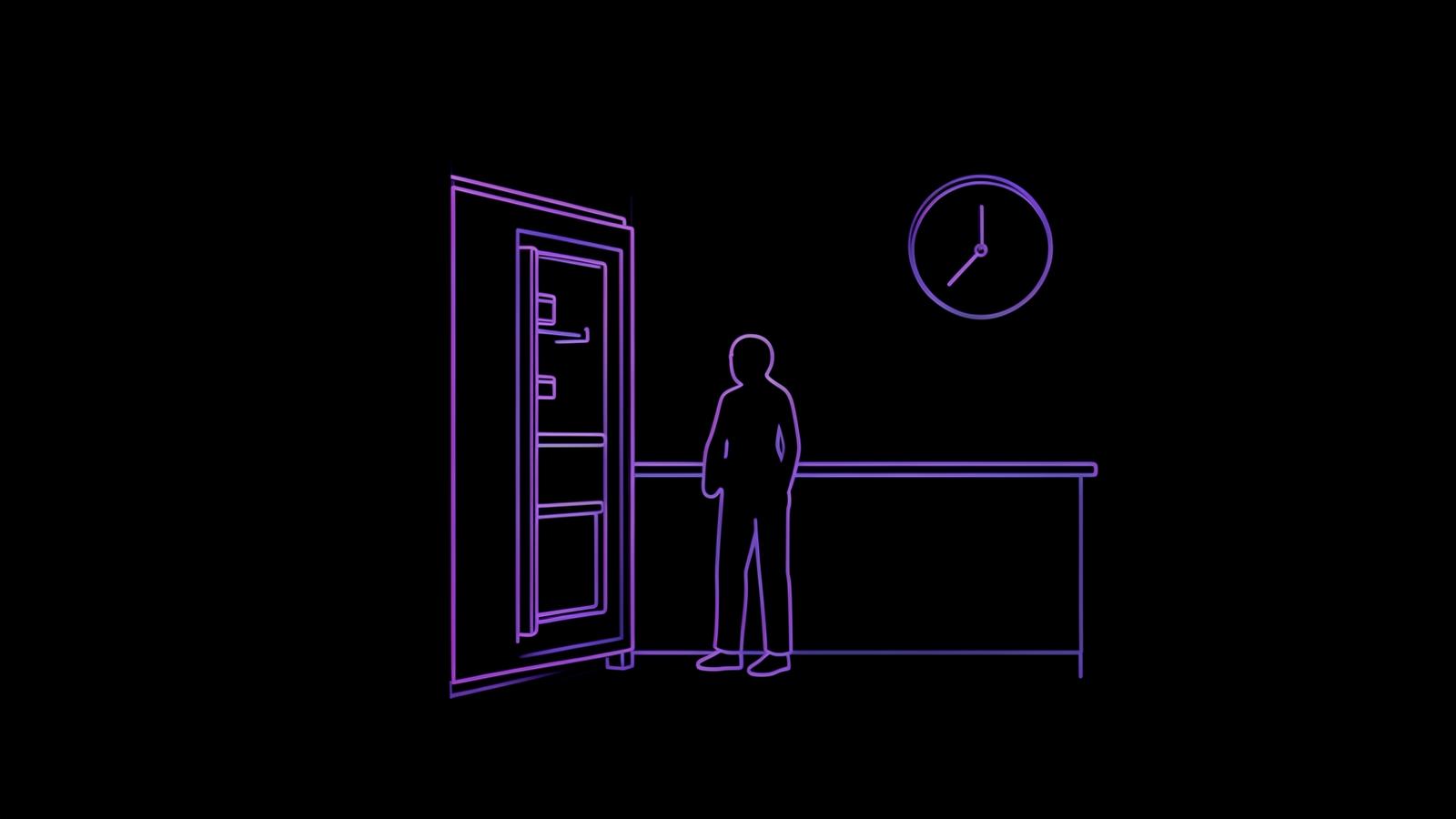
The daytime version of you is genuinely impressive. Sensible breakfast, decent lunch, resisted the office biscuits, felt fine. And then somewhere between the last email and bed, that person leaves the building and someone else is standing in the kitchen light eating whatever's nearest.
The most useful reframe available to you: this is almost never an evening willpower problem. It's a daytime setup problem with an evening trigger, and both halves have fixes.
Part of our guide to limerence recovery and getting someone out of your head.
Why it's always after dark
You are probably underfed by 8pm
A carefully-controlled breakfast, a light lunch and a skipped snack add up to a deficit your body will collect on. The starvation research is unambiguous that under-eating produces food preoccupation and loss of control — and the collection point is usually the evening, when there's finally nothing else to do. If you binge at night and eat sparsely by day, that's not a coincidence, it's a sequence.
Self-control genuinely runs thinner when you're tired
Whatever the ongoing debate about ego depletion, the practical observation holds: decisions made while exhausted skew towards immediate relief. Short sleep also shifts appetite hormones towards greater hunger and stronger reward response to energy-dense food. A 10pm decision is made by a differently-resourced brain than a 10am one.
The evening is a trained cue
Same sofa, same hour, same show, same behaviour, repeated for years. The urge that appears at 9pm isn't produced by hunger or by weakness — it's produced by context, the way a bell produced salivation. Which is genuinely good news: contexts can be changed far more easily than characters.
And it's the first quiet moment all day
Bingeing is often an emotion-regulation strategy, and it works in the short term — the numbness people describe partway through is the actual reward. Evening is when the day's suppressed feeling arrives with nothing to distract from it. Eating is the fastest available off-switch.
“It's like I go on autopilot at 9pm. I'm not even tasting it. I come back to myself when the packet's empty and I can't account for the last twenty minutes.”
What actually breaks it
01Eat more before 4pm, not less
This is the intervention people resist hardest and it is the one that moves the needle. Add protein and fibre to breakfast and lunch, and put a real afternoon snack in the calendar. Regular eating is the foundation of cognitive behavioural treatment for binge eating precisely because it removes the deficit the evening is repaying.
02Plan an actual evening meal, and eat it at a table
Not grazing while cooking, not leftovers standing up. A defined, finished, sufficient meal creates an endpoint. Bingeing thrives where there's no endpoint.
03Break the cue in the first ten minutes
When the urge lands, change the physical context immediately — different room, outside for five minutes, cold water on your face, shoes on. You're not resisting a craving, you're removing its trigger conditions. Ten minutes of interruption defuses more urges than an hour of arguing.
04Breathe out longer than you breathe in
Four counts in, six to eight out, two minutes. Extended exhalation increases vagal tone and shifts you out of a stress-driven state, which is what most 9pm urges actually are underneath.
05Put a wall between you and the phone
Delivery apps are the modern night-binge mechanism. Log out, remove saved cards, delete them from the home screen. Friction added in advance beats resolve applied in the moment, every time.
06Move bedtime earlier by thirty minutes
You cannot binge while asleep, and short sleep measurably increases next-day hunger and reward-seeking. Nothing good has ever been decided at 1am in a kitchen.
07When it happens, don't compensate
No skipped breakfast, no punishment workout, no starting over. Compensation recreates tomorrow night's deficit exactly. Eat a normal breakfast the next morning — that single act does more than any amount of resolve.
Expect the shape, not a switch
Recovery from night bingeing tends to look like five nights instead of seven, then three, then a fortnight, then a bad week that isn't a return to the start. The nights you get through unremarkably are the ones doing the work, even though they never feel like achievements.
Frequently asked questions
Why do I binge eat at night but not during the day?
Usually because the daytime is where the setup happens: restricted eating creates a deficit that the evening repays, tiredness reduces the resources you make decisions with, and years of eating at the same hour in the same chair have trained the cue. Evening is also the first unoccupied moment, when suppressed feelings surface and eating becomes the fastest available relief.
How do I stop the urge to eat at night?
Interrupt the context rather than fighting the craving: change rooms, step outside, or do two minutes of extended-exhale breathing, since most urges peak and fall within about twenty minutes. In parallel, remove access friction in advance — log out of delivery apps and delete saved cards — and make sure you actually ate enough earlier in the day.
Should I just not keep binge foods in the house?
Reducing easy access to your specific trigger foods genuinely helps in the short term, and it's a reasonable stabilising step. Long term, total prohibition of a food tends to increase its pull, so most approaches move toward planned, calm inclusion once the pattern has settled rather than permanent bans.
Is it bad to eat late at night?
Eating in the evening isn't inherently harmful; a sensible dinner or an evening snack is fine. The problem is compulsive, distressing, out-of-control eating and the shame and restriction that follow it. Aiming to eat adequately earlier is about breaking that cycle, not about the clock being morally significant.
Why do I feel like I'm on autopilot when I binge?
Many people describe dissociation or numbness during a binge, and that relief from feeling is often the real reward rather than the food. It's also why intervening at the very start of the urge works far better than trying to stop midway, once the automatic sequence is already running.
Does eating more during the day really reduce night bingeing?
For most people, yes, and it's the change with the strongest support. Establishing regular, adequate meals and snacks is the first step in cognitive behavioural treatment for binge eating, and it typically reduces binge frequency on its own by removing the deprivation that fuels evening urges.

Silence
Kill the food noise. Break the binge cycle.
A recovery toolkit for food noise and binge eating. Track binge-free streaks, log triggers, use the panic button, and reclaim your relationship with food.
Learn more about Silence